Results
Congratulations! You did GREAT!
Now you can visit the museum and see all of these part of a tank in person and up close.
See you soon!

Congratulations! You finished but have a bit to learn!
Now you can visit the museum and see all of these part of a tank in person and up close.
See you soon!


In World War One, armies stayed in trenches and were separated by a area of mud, water, wire, and craters. This was called “No Man’s Land”. It was very difficult for soldiers or horses to move across this area because it was covered by machine guns. Tanks were developed to traverse this area (high mobility), with their armour (protection against bullets), and their own guns (firepower). They would provide protection to the infantry soldiers that attacked with them.
#1. Who helped design the first tank in World War 1?
This is a picture of a British Mark IV tank from the first world war.
The first tanks were developed by the British “Landship Commission”. Because British Navy ships had armour, engines, and guns – Naval Engineers had the knowledge and experience to build these new vehicles.
You can still see the legacy of the engineers today with the terms used by tanks, Tanks have decks (not floors), bulkheads (not walls), hatches (not doors) etc.
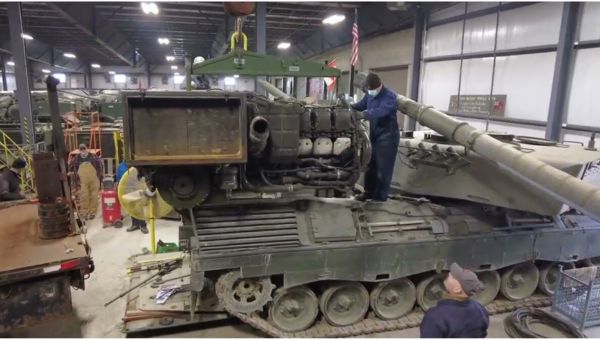
Older tanks mechanics had to climb inside tanks in order to work on them. In some tanks, they would have to even remove the turret to fix things. Nowadays, smart mechanics like thes guys can take important pieces out of the tank using a crane and work on them easier. What are they removing to work on?
#2. This is the part that makes a tank go.
This is a power pack. It is more than an engine. It is a single piece that contains an engine, radiator, and transmission.
Old tanks had separate engines, transmissions, and radiators. Taking them out for repair or maintenance could taake from hours to days.
Modern tanks have everything in a single power pack. With the right equipment, mechanics like these can remove a power pack from a tank in about thirty minutes. They can then take another power pack and drop it into the tank. Then the tank can leave and the mechanics can work on the engine without crawling around in the tank.
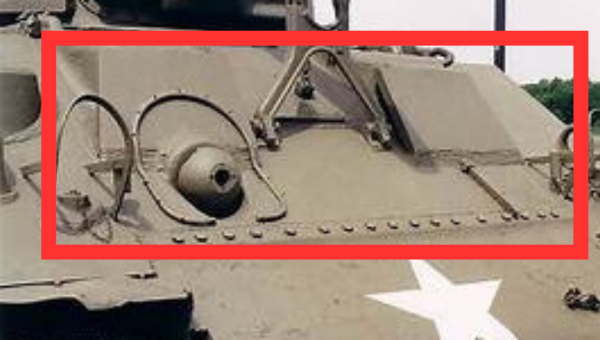
The front of the tank is exposed to the most danger. It is normally the thickest armour on the tank. It is also sloped to help ricochet incoming projectiles. It can also be slippery and icey so you have to be careful walking on it or you’ll fall off and break your arm (I did).
#3. What is the sloped part of the front called
This term does not come from the navy. This comes from military engineers in the old days. Glacis is a old french word glacer meaning to freeze or slide. Old forts and castles would have strong stone walls but these would not last long against cannons. So, a large earten or dirt sloping mound was built on the outside of the fort’s walls to deflect or absorb cannon balls.
Teh picture is the glacis on a M4 Sherman. You can see this at the Museum but also on the Leopards and Chieftains.
It is hard to see out of a tank.
#4. How do they see?
This is a tricky question. In most cases the driver just sticks his head out of the tank hatch. In some old tanks, they could not because the driver did not have a hatch. The commander still tells the driver where to go A Ground Guide will help the driver when needed in buildings or other tight situations (you can see ground guides at work at the Museum when tanks are moving.). In some modern tanks, the driver has a rearview camera for backing up.

This is the part of a tank that gives it high mobility.
#5. What are these?
This is the running gear of the tank, usually callde the suspension. It has a drive sproket (spiked wheel at the front that moves the tracks), road wheels at the bottom that spread the weight of the tank), and an idler at the back that maintains the right track tension.
There are different types of suspensions that you can see at the Museum. Ask a guide to show you the parts.

The crew is the most important part of a tank. In Canada and the United States, Tank crewmen are called “Tankers”. In England and Austrailia, they are called “Tankies”. In Germany they are Panzersoldat.
#6. Who is in a Tank Crew?
Very early tanks had only 2 crew (like our M1917). The Sherman has 5 crew but most modern tanks today have 4 crew (Driver, Loader, Gunner, and Crew Commander). The Crew commander is in charge of the tank and crew. The number 2 is the Gunner in Canada but in Britian, it is the Loader.
In some tanks (mostly French and Russian) the loader is replaced by a machine to load the gun.
The picture is of a Canadian Tank crew on their Leopard 2 tank in Afghanistan getting ready for Canada Day.
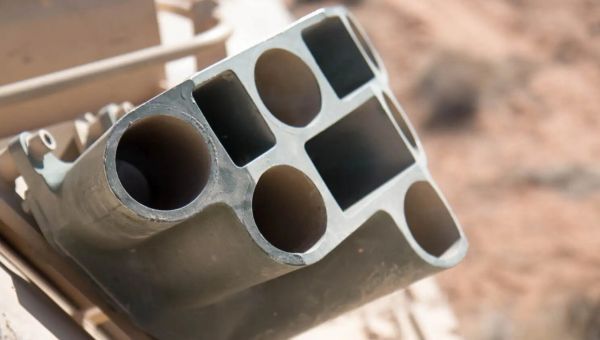
Sometimes a tank needs to hide. Modern tanks uses these things to help.
#7. A tank uses this to disappear.
A smoke gernade launcher can shoot a curtain of smoke in front of thae tank. This stops the enemy from being able to aim at the tank. When this is used, it is called “popping smoke”.
It used to be plain smoke but modern tanks use a special “smoke” that blocks not just vision but also thermal imagery and other optical systems.
This one is from an M60. Can you find it at the Museum? Different tanks have differnt smoke launchers in differnt places. Can you find them all at the Museum?

This is another naval term. It usually hoilds two or three members of the crew plus radios, ammunition and the main/secodnary armament.
#8. The spinning thing on top of a tank is called the:?
Tanks normally have a single turret but the British devloped the Vickers Independant in 1926. It had five turrets. It also had the first tank electric intercom system. Only one was ever built.
However, German spies stole the plans and Germany built the Neubaufahrzeug of which they made five. It had three turrets.
The Russians then stole the plans from the Germans and produced the T-35 with eight to ten turrets and the t-28 with three turrets. These Russian versions actually went into production and saw combat but faired badly.
Multiturreted tanks never became popular.
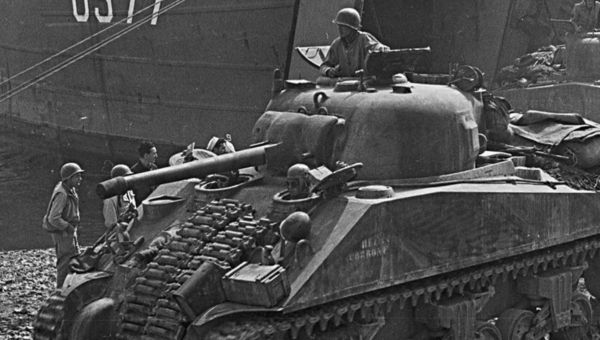
Teh picture is of a Sherman Tank. This one is at the Museum in Base Borden.
You can see on many tanks (and other vehicles) in our Museum.
Don’t touch them! They are heavy and dirty.
#9. What are these “ropes” used for?
These are called TOW CABLES.
A tank cannot call a tow truck from the gas station.
They are so heavy that they need either another tank or a specialzed Armoured Recovery Vehicle (ARV) to pull it out of trouble.
The tank has two tow points on both the front and back.
The picture is of a German Leopard 2 being towed by a Leopard ARV.

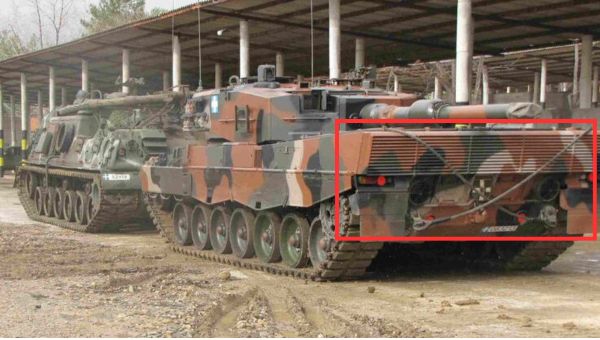
This a big clamp. It is on the front of tanks like the Sherman and sometimes on the back of tanks like the Leopard.
#10. Sometimes this is on the back of the tank and sometimes on the front. What is it?
Another trick question. This is called a TRAVEL LOCK in some countries (like Canada) or a GUN CRUTCH in other countries (like Britian).
This is used to hold the gun barrel in place during long moves on trailers, trains, ships, airplanes or even the tank driving itself.
This reduces the strain and potential damage to the tanks elevation (moves the gun up and down) and its stabilization systems (stops the gun from moving off the target when the tank moves.)
This one in the picture is from a Chieftain. You can find them on many of the tanks at the Museum.