
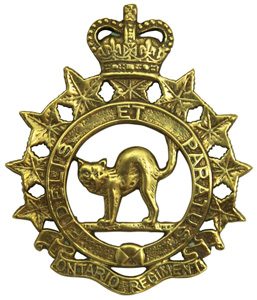
July 2026 marks the 100th anniversary of the Ontario Regiment cap badge. In the past century the only change has been the crown. For the vast majority of the hundred years it has been worn on the black beret of the Royal Canadian Armoured Corps, leading to the Regiment’s nickname, “the Black Cats”. The origin of the cap badge dates to earlier than 1926, back to the early 20th Century.
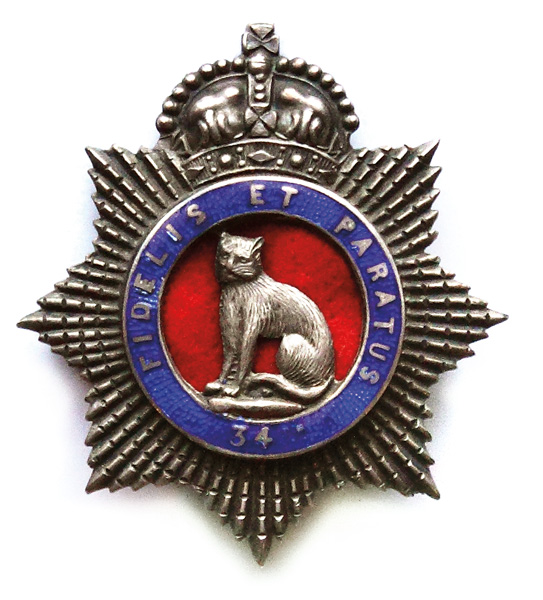
Origin
The predecessor of the Ontario Regiment cap badge stems from the time of Lieutenant-Colonel McGillivray’s tenure as commanding officer. At this time, regiments were able to design their own cap badges. Lieutenant-Colonel McGillivray selected an element of his family’s crest, the seated cat, for the Regiment’s distinctive cap badge. The badge was authorized in 1912 but photos show it in use prior to that.
The Cap Badge
The cap badge that identifies the Ontarios was authorized by General Order 48 on 17 July 1926. The order described the cap badge as:
A Tudor Crown supported by a wreath of nine maple leaves; the wreath encircling a circular device bearing the words of the motto of the Ontario Regiment “FIDELIS ET PARATUS”. The bottom of the circular device bearing three-fourths of a super-imposed circular disc. The circular device encircles a cat; statant guardant irate. A scroll below carries the name “ONTARIO REGIMENT”.
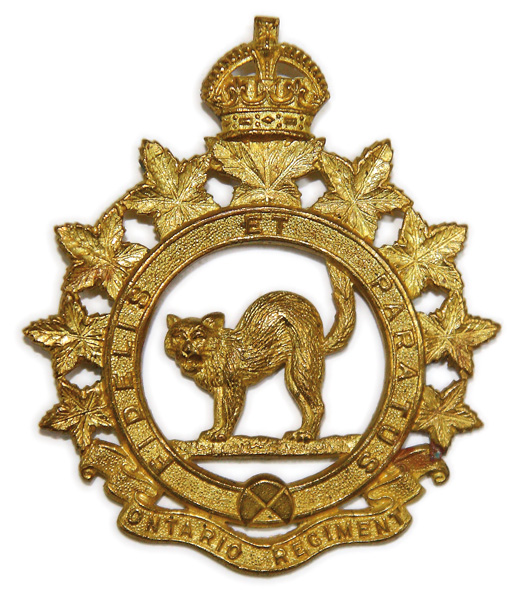
The Tudor Crown was the official crown of reigning monarch, King George V. The Regiment’s motto, “Fidelis et Paratus”, is Latin for “Faithful and Prepared”. An alternate interpretation is “Faithful and Ready”. The nine maple leaves represent the nine provinces in Canada, each of which contributed men to the 116th Battalion; Newfoundland and Labrador did not join until 1949.
The curious element is the “three-fourths of a super-imposed circular disc”. In 1920 the Regiment was renamed from The 34th Ontario Regiment to simply, The Ontario Regiment. The numbering system used by the Militia since the 1860s was being removed. Numerals were also barred from cap badges around this time (with some exceptions). The Regiment felt it was losing part of its history by omitting the “34” from the new cap badge. The three-quarters (or ¾) of a circle was the answer to adhering to the regulations but still maintaining homage to the Regiment’s history by symbolically including the numerals “34.”
It was also decided that a change in the appearance of the cat was in order. The general feeling of the Ontarios was that a seated, and somewhat sedate, cat of the original badge did not accurately reflect the experiences of men who had fought in the Great War. The cat was changed to the fighting pose that still exists on the cap badge today.
An Update
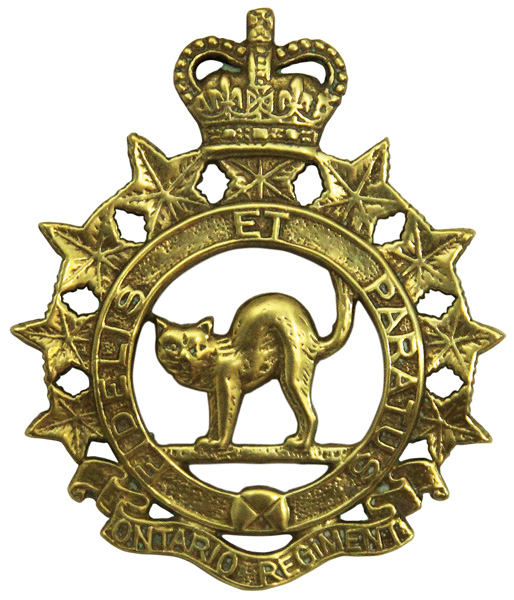
Upon her ascension to the throne, Queen Elizabeth II chose the St. Edward’s Crown. The Ontario Regiment’s cap badge was officially modified to incorporate this crown in 1958, but photos show the Tudor Crown cap badge lingering until well into the 1960s. There were a significant number of cap badges to be used up before issuing new ones.
The Tudor Crown is sometimes colloquially referred to as the “King’s Crown” and the St. Edward’s Crown as the “Queen’s Crown”.
The Future
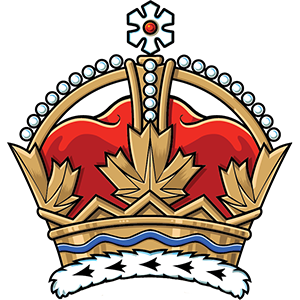
King Charles III has selected to the Tudor Crown for his use. Does this mean that the Ontario Regiment will revert to the cap badge previously used? It would seem it will not as there is now a third crown in the mix – the Canadian Royal Crown. The Canadian Armed Forces are in the process of modifying all unit identifiers to incorporate the new crown, which will be used in perpetuity. There will be no changes to the crown used based on the one selected by future monarchs. The CAF web page explaining the transition notes that the change will happen over many years while the existing stock of badges are issued.
Rod Henderson is the Regimental Historian of the Ontario Regiment. He served as a Sergeant in the Regiment and is the author of “Fidelis Et Paratus: A History of The Ontario Regiment (RCAC), 1866-2016”.