
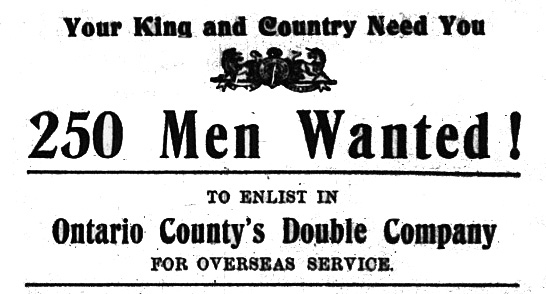
The First World War was into its second year in September 1915. Ontario County had contributed hundreds of men to the Canadian Expeditionary Force through the first three overseas contingents and smaller follow-on drafts. At this time Major Samuel S. Sharpe was the recruiting officer and second-in-command of the 34th Ontario Regiment. Sharpe’s civilian occupation was a lawyer. He entered politics in 1908 and was elected as the federal Member of Parliament for the riding of Ontario North, a position he still held in late 1915.
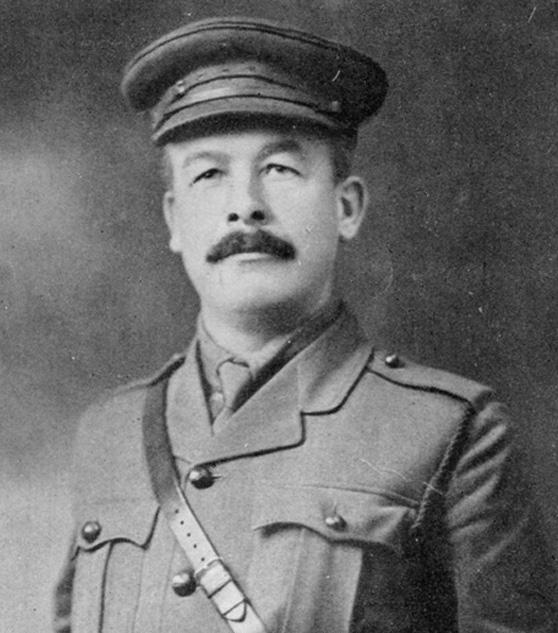
Major Sharpe contacted Sir Sam Hughes, Minister of Militia and Defence, in September 1915 with an offer to raise a double company of 250 men in Ontario County. Hughes accepted the offer and the organizational work began. Captain Henry P. Cooke of Uxbridge was named the commanding officer. Headquarters for the double company, with a machine gun section, was established in Oshawa.
Recruiting began in mid-September and Captain Cooke wrote a letter to the County’s newspapers, outlining the recruiting goals for each community. He pressured the local men by stating, “It would be well to press on the boys the duty of enlisting in their own County Regiment.” The letter indicated that the double company would be kept together and would eventually join a battalion in its entirety.
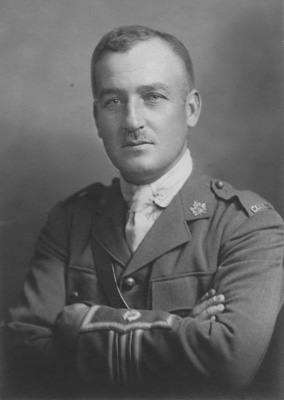
Major Sharpe reported on 25 September that 40 men were already training in Oshawa. There was a request for these men to be transferred to the 37th Battalion, as it was still understrength. There was a strong contingent of soldiers from Ontario County in that battalion. Sharpe immediately jumped to the defence of his double company, writing to Colonel W.A. Logie, the officer commanding the 2nd Division (the Militia division, not the overseas CEF division), noting that the men had, “had enlisted on the definite distinct understanding that they would remain with Ontario County’s double company as a unit.” Sharpe added that it “would be a breach of faith” if they were transferred in small groups to other battalions. This request went all the way to Sam Hughes who approved the men to remain in the double company.
In a sign that some things have not changed since the early 1900s, Major Sharpe felt compelled to write a letter to the Whitby Gazette and Chronicle in late September to quash a rumour that he was being paid $25 for each recruit. He further noted that he was not accepting the pay he was entitled as a major, nor was he requesting remuneration for any of his expenses associated with the recruiting events.
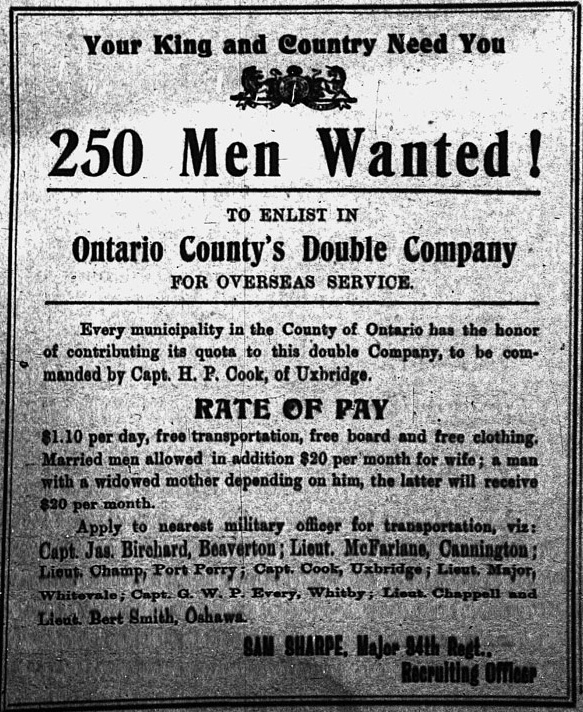
Recruiting events took place in Oshawa, Whitby, Uxbridge, Port Perry, Sunderland and Beaverton. On 30 September Sharpe reported to the 2nd Division that the double company was now at 98 soldiers. He indicated that there were a further 175 men who were sworn in but could not begin training due to their obligations to the farmers that employed them. Whatever training that was being conducted would have been very elementary. Sharpe wrote to various authorities seeking uniforms and equipment. He stated that the lack of uniforms was an impediment to recruiting and was impacting the morale of the men currently undergoing training.
In late September Major Sharpe met with Sam Hughes in Ottawa and Sharpe was promised the command of an overseas battalion by Hughes. The recruiting area was not defined, but Sharpe suggested that three companies could come from Toronto to be added to the double company in Ontario County.
Also in September and October there were discussions in the Militia that future battalions should be raised by each county. There was some debate in the newspapers over which county was the first to initiate the idea – either Huron County or Ontario County. Regardless of which county deserves the honour, the county-based system of raising battalions caught on across the country and became the most common method.
By late October there were newspaper reports that Major Sharpe had already initiated the recruiting for a full battalion. On 12 November 1915 Major Sharpe received a letter from the Assistant Adjutant-General, 2nd Division indicating that the Minister of Militia and Defence had authorized a full battalion to be raised from Ontario County and it would be designated the 116th Overseas Battalion, CEF. The formal authorization for the creation of the 116th Battalion came in General Order 151, dated 15 December 1915. The new Battalion was already well under way by that date.
Rod Henderson is the Regimental Historian of the Ontario Regiment. He served as a Sergeant in the Regiment and is the author of “Fidelis Et Paratus: A History of The Ontario Regiment (RCAC), 1866-2016”.