
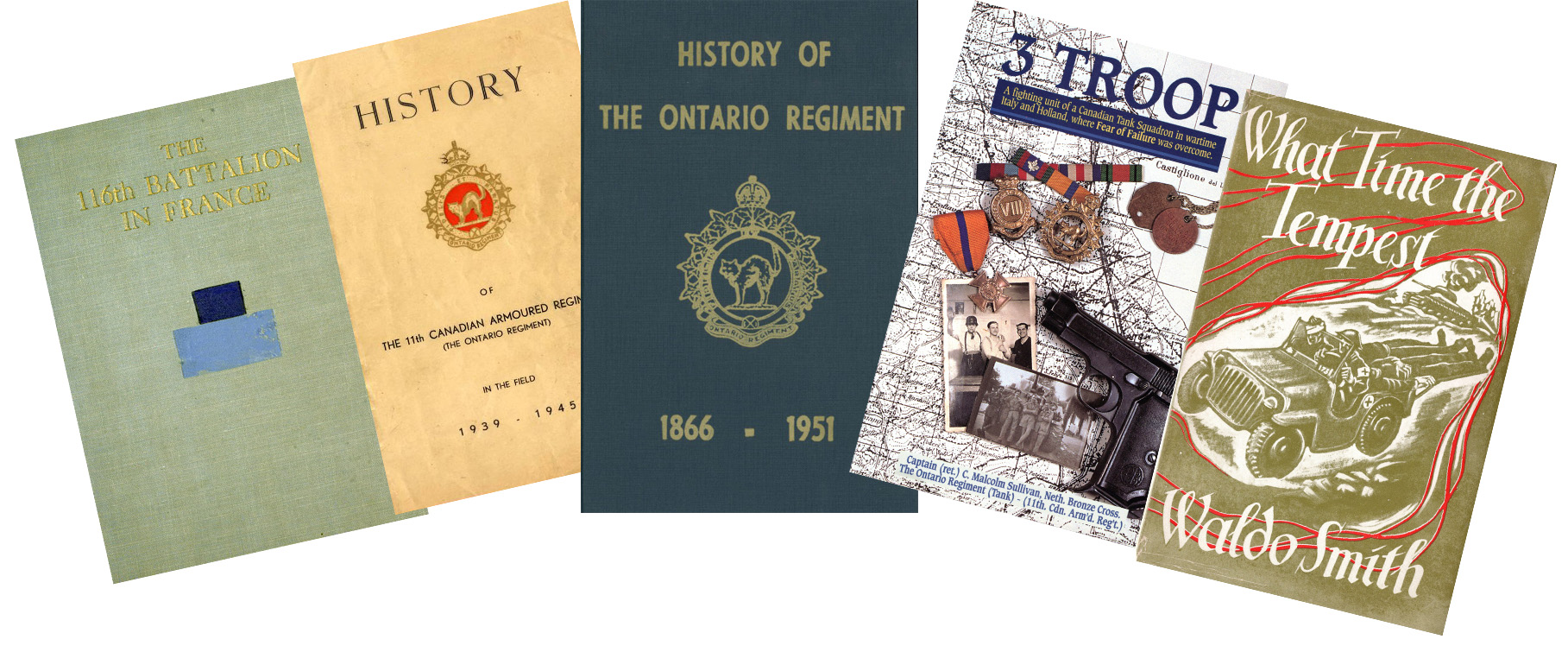
April 30, 2026 marks the 10th anniversary of the release of “Fidelis et Paratus: A History of the Ontario Regiment 1866-2016”. A book launch was held at the Colonel R.S. McLaughlin Armoury in Oshawa on that day. I was happy that the Regiment’s remaining known Second World War veterans, John Richardson and Ralph Kearney, were able to attend.
Numerous sources were used to write the Regimental History. Some of the most important were the previous histories and books written by the veterans themselves.
The 116th Battalion in France
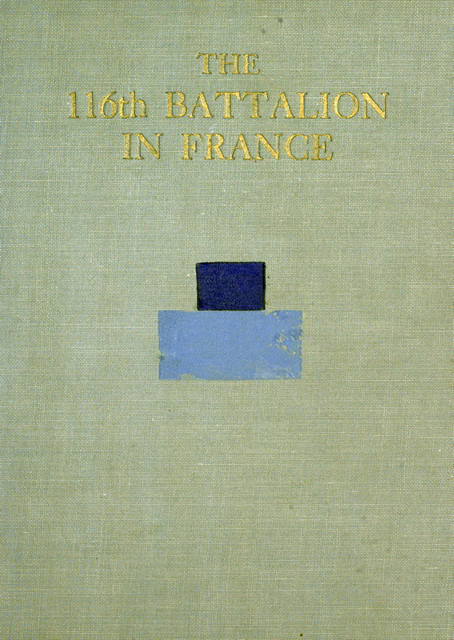
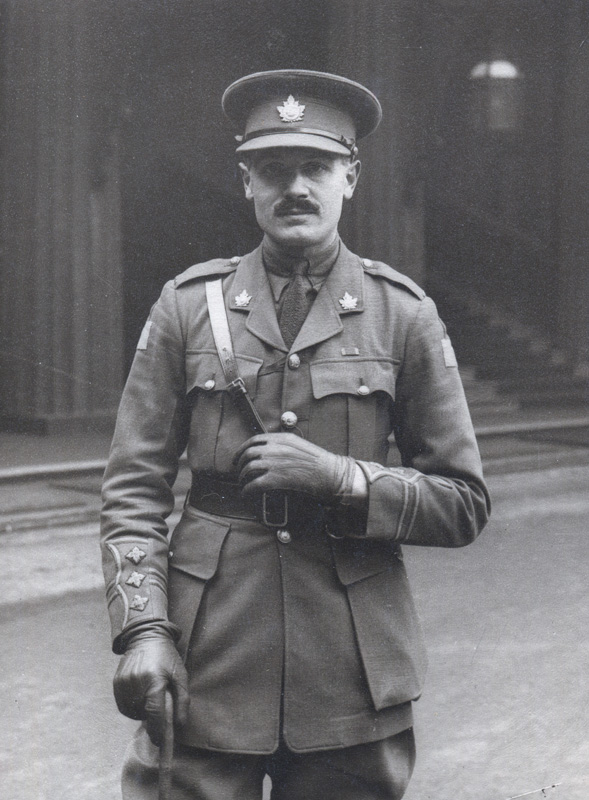
The first official history was the “116th Battalion in France”, released in 1921. The cover credits the author as “The Adjutant”. Inside the cover, it is noted that this is E.P.S. Allen. Captain Evelyn Allen was taken on strength of the 116th Battalion in February 1917, just as they were preparing to move to France. He was the “B” Company commander for a time, but spent much of the war as the Battalion’s adjutant.
As the title suggests, the book primarily focuses on the Battalion’s time in France. The preface to the book states that the book was intended for the veterans of the 116th and their families. In letters to several newspapers Allen stated that the intention was to give a copy of the book to the family of each member of the 116th killed in action and to the surviving veterans. The first few pages cover a brief history of the 34th Ontario Regiment and the recruiting conducted in Ontario County during the First World War.
Given the stated purpose of the book, it is not surprising that it is written in a somewhat familiar style that would be unusual in any other context. It gives great insight into the events that were not recorded in the war diary or other official documents. The book includes photographs of all the officers killed during the war and a selection of other photographs.
The Roll of Honour is listed at the back of the book. It was as accurate as could be compiled at the time. A more complete list is presented in “Fidelis et Paratus: A History of the Ontario Regiment 1866-2016”.
Original copies of the book are difficult to find and are usually quite expensive. A modern reprint is available from battlefields.ca (link). It is also available for free from archive.org (link).
History of the 11th Canadian Armoured Regiment (The Ontario Regiment) in the field 1939 – 1945
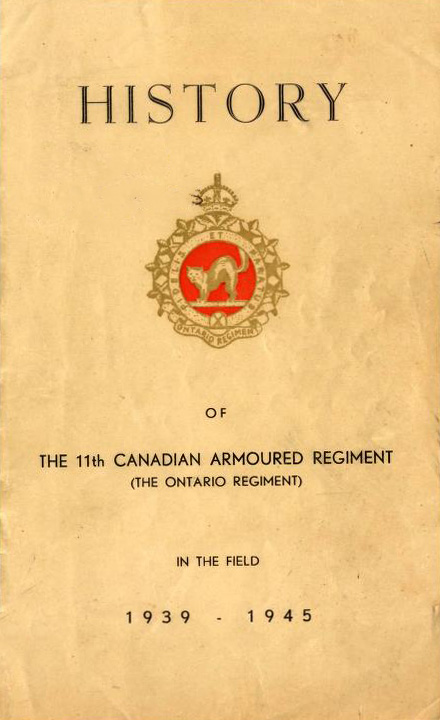
The Ontario Regiment spent most of the summer of 1945 in Harlingen, Netherlands following the end of the Second World War. During this time Major John Slinger and Captain Dunstan McNichol spent several weeks writing the Regiment’s war history. They were assisted by Troopers D. Urquhart, C.H. Raycroft, J.J. Sheedy and Lance Corporal S.F. Harrison. The 44-page book was published in September and was titled “History of the 11th Canadian Armoured Regiment (The Ontario Regiment) in the field 1939 – 1945”. It eventually became the foundation for the full regimental history published in 1951.
The first two pages outline the history of the Ontario Regiment prior to the war and the Regiment’s activities during the war, leading up to Sicily. Although the book is brief, it provides more detail than can be obtained from reading the war diary.
A copy of this book can be found at archive.org (link).
History of the Ontario Regiment 1866-1951
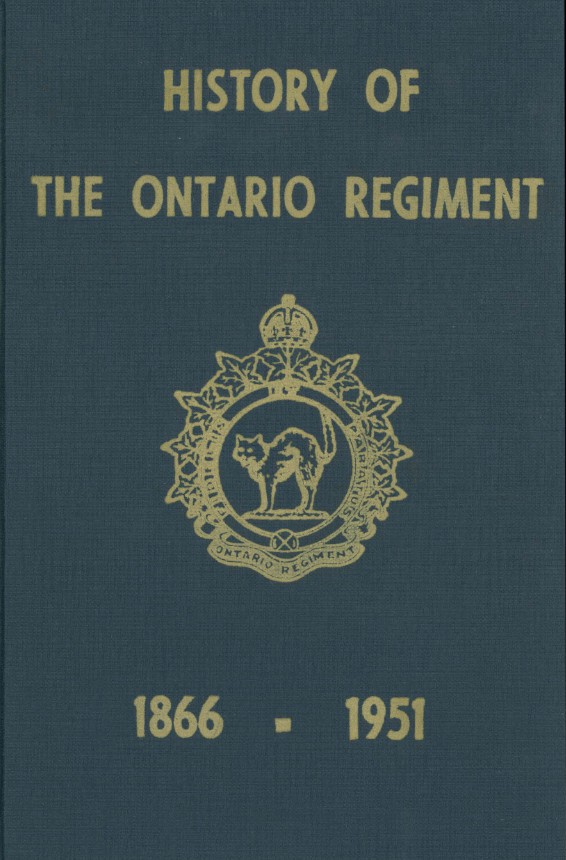
The first attempt at a full regimental history was released during the Regimental Reunion weekend at the Oshawa Armoury on 25 November 1951. “History of the Ontario Regiment 1866 – 1951” was written by Captain Lex Schrag, with the input of many of the Regiment’s Second World War officers and leaned heavily on the 1945 publication described above. As such, the book predominately covers the Second World War, with pages 45-277 of 286 total numbered pages dedicated to that conflict. Schrag was a columnist for the Globe & Mail newspaper. Funding for the book was provided by Honourary Colonel R.S. McLaughlin. Copies were provided to all the Regiment’s Second World War veterans.
The history of the Regiment prior to 1939 is somewhat thin and not fully accurate. Former commanding officer Colonel Frank Chappell was an amateur historian and provided much of the content for this section. Source material was not as readily available as it is today and it appears that it relies on Regimental legend in some instances. The book includes a good selection of photographs from the Second World War. Unfortunately, the captions are not detailed or complete. Some pages have only, “Some Interesting Moments”, “Candid Shots” or “Remember These Spots?” for captions.
The 1951 Regimental History includes many personal stories that are not documented anywhere else. Without this book, these stories would have been lost forever. Many of these were included in the 2016 History.
The Roll of Honour is included in the book and reflects the list as it appears in “History of the 11th Canadian Armoured Regiment (The Ontario Regiment) in the field 1939 – 1945”. It is not clear how it was decided who appears on the Roll, but research for the 2016 History found that many names were missing from the 1945 and 1951 lists. In some cases they were soldiers who died in accidents or by suicide. There are also names of soldiers who had been in the Ontario Regiment but were killed after they transferred elsewhere.
Printed copies are difficult to find today, but a digital version is available through the University of Calgary (link).
What Time the Tempest: An Army Chaplain’s Story
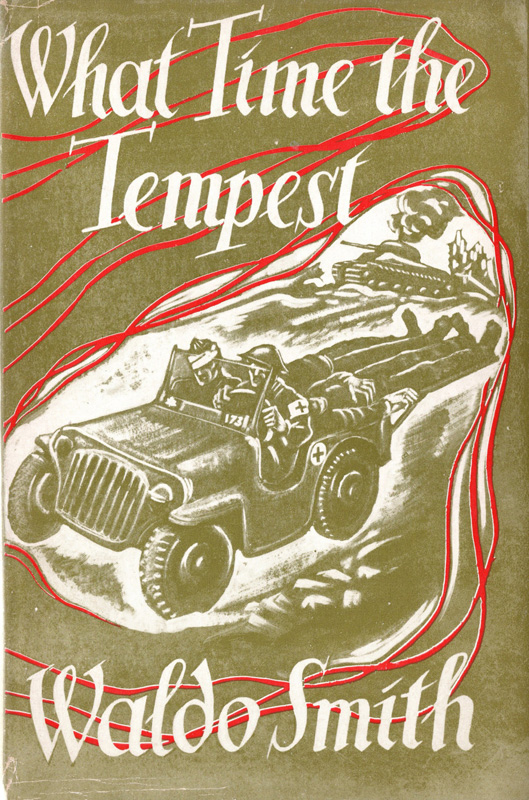
One of the Ontario Regiment’s wartime chaplains, Honourary Major Waldo E.L. Smith, released his memoirs in late 1953. The book, “What Time the Tempest: An Army Chaplain’s Story”, covers his time as a chaplain with various units of the 1st Canadian Armoured Brigade. About half the book details his assignment to the Ontario Regiment. Smith was transferred to the Ontario Regiment when they were at Stobbs Camp in Scotland in June 1943. The Ontarios were making final preparations to sail for Sicily. He left the Ontarios in June 1944 and was next attached to the 1st Canadian Corps Transport Column.
H/Major Smith presents a different point of view of the war than a reader would normally get from a military memoir. His role as a chaplain put him in contact with all ranks, from the troopers to the commanding officer and even the brigadier. He worked in casualty evacuation during periods of combat, enabling him to provide observations on the fighting experience as well as spiritual matters. Smith describes the challenge of casualty evacuation, balancing the desire to be close to the action in order to quickly pickup the wounded, but not so close as to become a casualty himself.
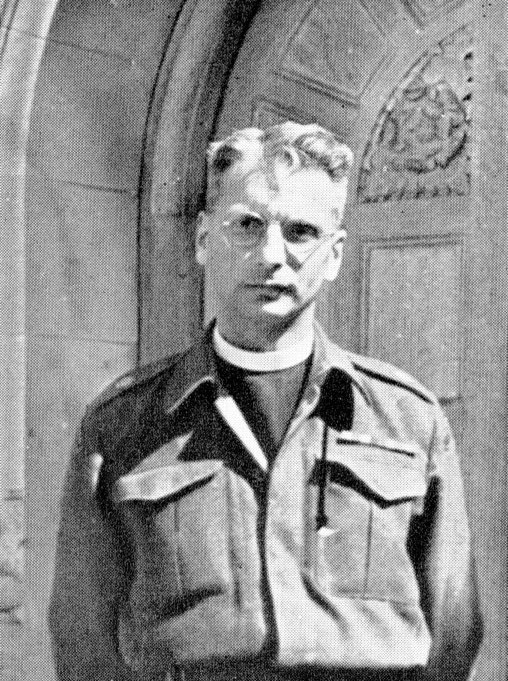
As chaplain, he was provided with a jeep and assigned a driver. The jeep was required to enable Smith to carry out his duties due to the Regiment’s squadrons rarely being located in close proximity to each other. In addition to performing religious services and carrying out casualty evacuation, he visited soldiers in the hospital, conducted memorial services, delivered mail, spent time with the troops to provide moral and emotional support, and generally did whatever he could to improve the lives of the soldiers.
Smith’s first driver was Trooper Fred Ware who came from the Calgary Regiment with him. Ware died of wounds received in December 1943 when a tank drove over a mine near where he was standing. He was replaced by Trooper Cecil Westover, normally known by his nickname, “Westy”.
Honourary Major Waldo E.L. Smith was born in the County of York, Ontario in 1901. He was a graduate of the University of Toronto and was ordained in 1926. Smith taught at Albert College in Belleville, ON. The November 2025 article includes a brief biography of Smith.
“What Time the Tempest” can still be occasionally found in used bookstores.
3 Troop
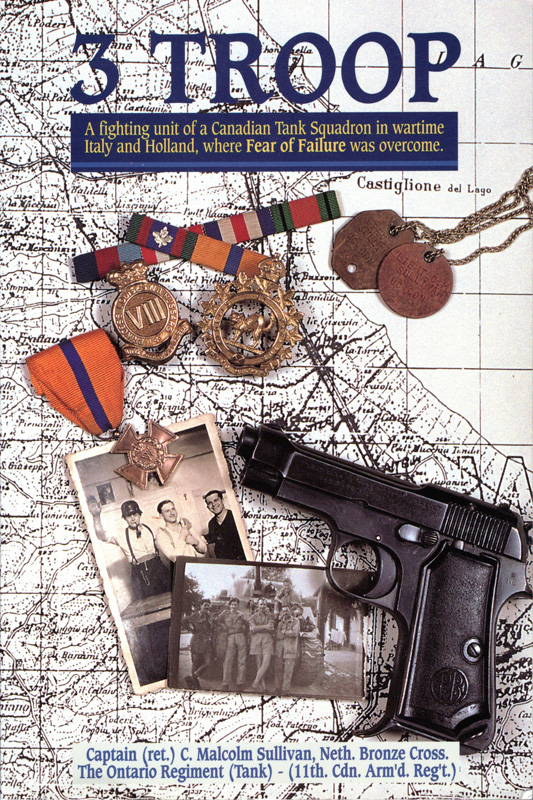
Former troop leader Captain C. Malcom Sullivan released his memoirs in 1998. “3 Troop”, named after the troop he commanded, also included the sub-title, “A fighting unit of a Canadian Tank Squadron in wartime Italy and Holland, where Fear of Failure was overcome”. “Fear of failure” is a concept that Sullivan refers to repeatedly in the book.
Sullivan grew up in Saint John, New Brunswick and joined the 8th Princess Louise’s New Brunswick Hussars in 1940 at the age of 17. His potential for leadership was recognized which led to a promotion to Sergeant and then to the Officer’s Training Centre in 1942. He was assigned to the Ontario Regiment in January 1944, along with two other lieutenants. Sullivan remained with the Ontarios until after VE Day. In October 1945 he married Jean Moncaster in England and was struck off strength of the Regiment just before the Ontarios sailed for Canada.
The core of the book is comprised of Sullivan’s own memories but he adds context by quoting other sources. These include the 1951 Regimental History, the Regiment’s war diary, “What Time the Tempest”, and “The Canadian Army 1939 – 1945” (the official history by C.P. Stacey).
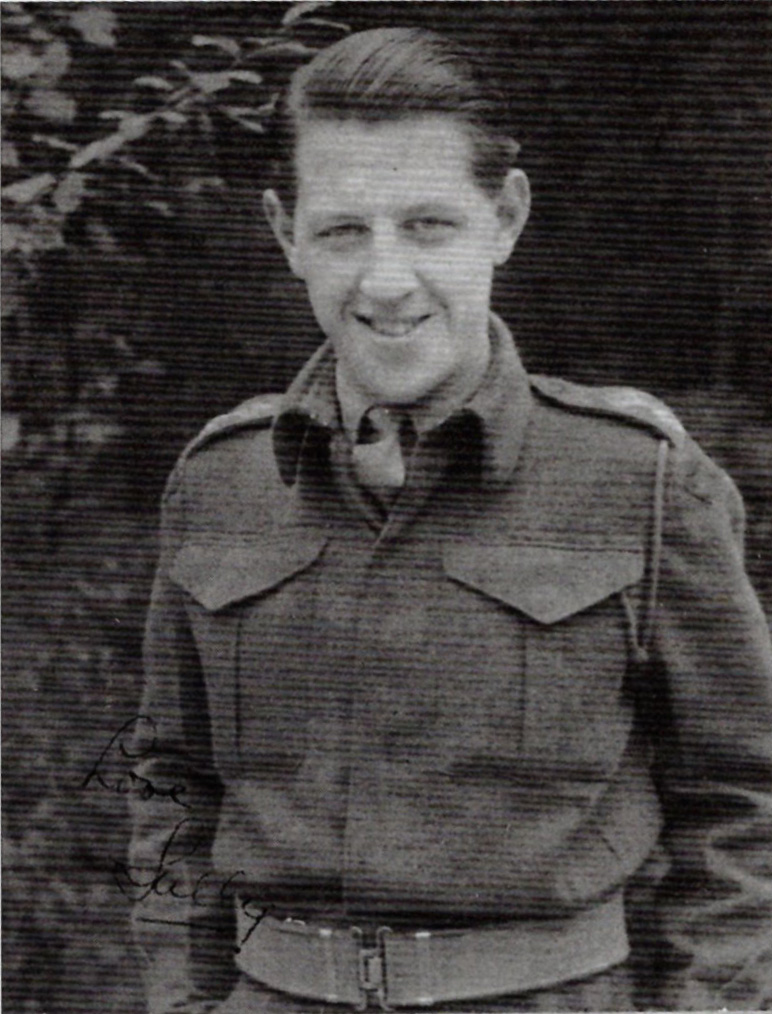
Sullivan includes several photographs, including personal shots from the war, official war photographs, and some from his trips to Italy in the 1970s and 1980s.
Sullivan’s narrative is different than Smith presents in “What Time the Tempest”. The chaplain had a role that covered the entire Regiment and could be seen as outside the combat element. Sullivan’s descriptions are much more personal within the group of 15 soldiers that made up a tank troop in Italy.
This book can still be found from online booksellers for a reasonable price, but it has been getting more rare in recent years. If you can find it, I highly recommend obtaining a copy.
Sullivan rarely uses last names when referring to soldiers, presumably for privacy reasons. He uses “Sgt Jim”, “Cpl Mike”, “Lt Bud”, etc. There is also the use of nicknames such as “Dutch”, “Yank” and “Slim”. The other ranks are difficult to decipher, but “Sgt Phil” is Phil Thornhill. It is made more complicated because he was “Cpl Phil” in the first part of the book and was promoted in June 1944 and a new crew commander joined the troop, also named Phil. He is “Phil2”. The officers are easier to determine as there were fewer of them. “Major Earle” is Earle Kennedy. “Lt Poco / Poc” is Murray Maidlow. He was nicknamed, “Poco” or just “Poke”, due to his short height. “Poco” means “little” in Italian.
Sullivan lists the members of the troop on page 133, along side a troop photo. The expanded list with the real name of each crewman, where it can be determined, is reproduced below. There is an extra loader-operator listed in the book.
| Name in Book | Crew Position | Real Name |
| Andy | Gunner | Andy Burch |
| Dutch | Driver | Jim Koopmans |
| Hedie | Gunner | |
| Jack | Loader-operator | Jack Marsden |
| Klondyke | Co-driver | George Chilverton |
| Knobby | Driver | Norman Aldridge |
| Lem | Gunner | Lemuel Scott |
| Malcom | Troop Leader | Malcom Sullivan |
| Phil | Troop Sergeant | Phil Thornhill |
| Phil2 | Troop Corporal | |
| Stack | Co-driver | Wilfred Barber |
| Slim | Loader-operator | Mervin Ahrens (killed in an accident) |
| Tony | Co-driver | Tony Favalaro |
| Yank | Driver | F.R. Childs |
| Doc | Loader-operator | |
| Mike | Loader-operator |
Rod Henderson is the Regimental Historian of the Ontario Regiment. He served as a Sergeant in the Regiment and is the author of “Fidelis Et Paratus: A History of The Ontario Regiment (RCAC), 1866-2016”.